
The Air Your Child Breathes at School: Why Location Matters More Than You Think

We analysed the location of 2,290 preschools in Singapore and found that dozens sit within breathing distance of major roads. Here's why that should concern every parent.

I'm an environmental scientist by background and way back in 2008 I was working for the London Borough of Camden's sustainability team. During a meeting our air quality officer presented the borough's air quality strategy. The science made sense and one thing in particular stuck with me more than anything else: it is small children who are most vulnerable to air pollution. Not just because their lungs are still developing, but because they sit in pushchairs, low to the ground, right at exhaust-pipe height. It made immediate, obvious sense and was quite alarming.
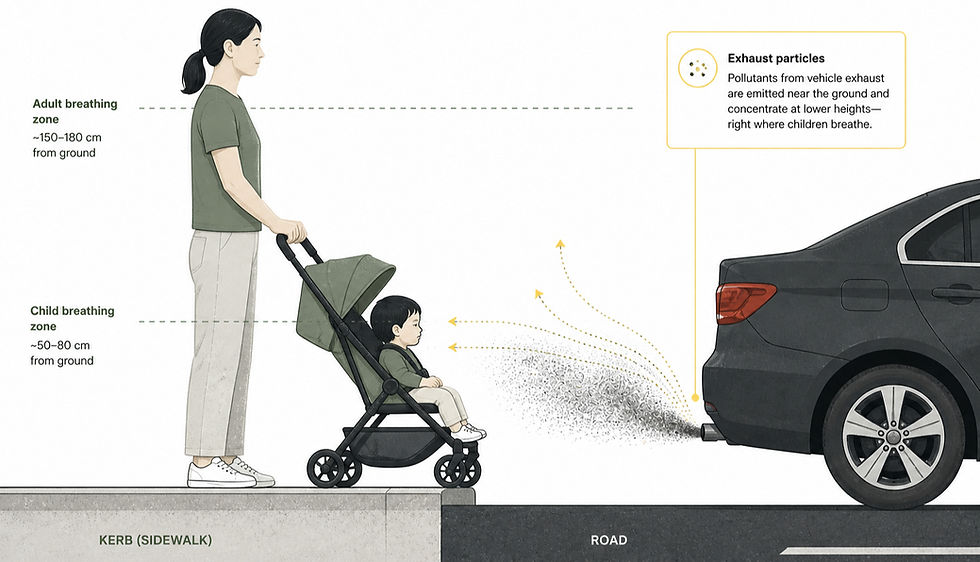
Illustration highlighting the particular risk to small children from road pollution.
Years later when I had my own children here in Singapore I always made sure to stand well back from the kerb when waiting to cross the road. Air pollution is an unseen issue, easy to forget about, but once you connect the cars, noise, smell, small children and the frequency and duration of exposure in a city environment, you can begin to see the potential for harm.
In 2018 I was sitting on the floor of my apartment located just off a busy arterial road, weaving a basket from palm leaves I had collected from the gardeners. I was experimenting to see whether palm leaf weaving could work as a Forest School activity! Within minutes my fingers were black, coated in fine dark particles that had settled on the surface of every leaf. The condo was maybe 50 meters from the road (but not far enough!).

Thick leaf from a location along a main road close to a young children's outdoor educational facility in Singapore. The paper towel was rubbed over the leaf briefly and shows the accumulated pollution which is also visible on the surface of the leaf.
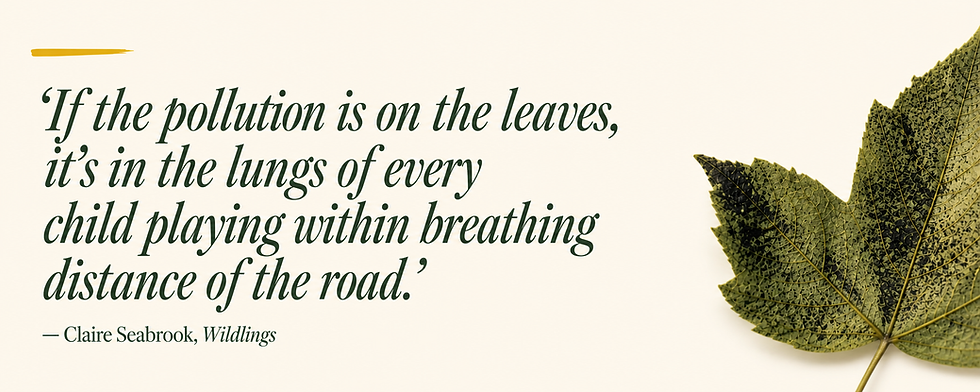
Research confirms that roadside vegetation acts as a sink for vehicle-emitted particulate matter, with studies showing trees near traffic capturing significant quantities of ultrafine soot particles from diesel and petrol exhaust (Weerakkody et al., 2018). The black residue on those palm leaves was, in all likelihood, deposited from the vehicles on the road beside us. If the pollution is on the leaves, it got there through travelling through the air and its in the lungs of every child playing outside within that distance of the road.
The question parents don't think to ask
When choosing a nursery or preschool, parents ask about curriculum, ratios, meal plans, and fees. What they rarely ask is how close the building is to a major road, and whether the outdoor play area sits within the zone where air pollution from traffic is at its most concentrated.
It matters more than most people realise.
We analysed the locations of all 2,290 licensed preschools in Singapore, using data published by the Early Childhood Development Agency (ECDA). We mapped every single one against the major arterial roads that carry the bulk of Singapore's traffic.
Click into the map above to see the locations of preschools in Singapore which are cause for concern.
Of these preschools, around 833 are standalone centres, the kind with their own buildings, gardens, and outdoor play areas rather than units inside air-conditioned shopping malls. Of those standalone centres, 99 are within 200 metres of a major road, 38 are within 100 metres, and 24 are within just 50 metres, essentially at exhaust-pipe distance.
A note on methodology here, this blog is not a scientific paper, and we are not claiming precise measurements or research. Our distances are estimated using publicly available ECDA location data and major road maps, calculating the straight-line distance from each centre's geocoded position to the nearest road curb. We have not physically measured each site with a tape measure, and the ECDA data points represent building locations rather than the exact boundary of each outdoor play area. The numbers are indicative, not precise, but the pattern they reveal is clear enough to raise serious questions, and we think parents and educators deserve to see it.
To be clear, a nursery inside a mall with filtered air is a different proposition. But a standalone preschool with children playing outdoors within 100 metres of a busy road raises serious questions, and the research behind those questions is well established.
Those numbers only cover ECDA-licensed local centres. They do not include international schools, many of which run their own early years and preschool programmes. Some of these schools sit alongside multi-lane highways and expressways, with outdoor play areas facing directly onto heavy traffic. Several actively market outdoor learning, nature-based curricula, and forest school as part of their offering, from sites where the air quality during outdoor sessions is, based on everything the research tells us, a genuine concern.
What happens to air within 100 metres of a busy road
A significant proportion of Singapore's air pollution comes from vehicle emissions. Ultrafine particles, the ones produced by car and diesel exhausts and small enough to cross from your lungs into your bloodstream, are at their most concentrated at the roadside. When you stand at the kerb, the concentration of these particles can be many times higher than in a park or green space set back from traffic (Zhu et al., 2002; HEI, 2010). This is a significant difference, and it is driven almost entirely by proximity.

Air quality dramatically improves with distance - children playing outdoors at schools within 50m of a major road are most at risk.
The good news is that pollution drops off with distance. Within 100 to 150 metres of a busy road, concentrations of ultrafine particles, black carbon, and carbon monoxide typically fall by 60 to 80 percent, and by 300 to 500 metres, levels return close to background (Zhu et al., 2002; HEI, 2010).
The bad news is that Singapore's building setback requirement for educational institutions is 7.5 metres from the road, with a 3-metre green buffer, making a total of 10.5 metres. That setback is a URA planning requirement that applies to the building structure itself, and it was designed primarily for noise and visual amenity rather than for respiratory health. The ECDA's Code of Practice for early childhood centres states that centres should avoid proximity to main roads and traffic hazards, but does not specify a minimum distance for outdoor play areas where children are physically active (ECDA Code of Practice, Fourth Edition, 2025). Research consistently recommends a minimum buffer of 100 to 150 metres between where children play and heavy traffic. The gap between what is required and what the evidence says is safe is enormous.
Why children are more at risk
Children breathe more air per kilogram of body weight than adults, at up to two to three times the rate of an adult relative to their body weight, according to the US EPA's Exposure Factors Handbook (EPA, 2011). Their lungs are still developing, forming the architecture that will serve them for life. They are shorter, which puts their faces closer to the height of exhaust pipes where pollutant concentrations are highest. And they are more likely to breathe through their mouths during physical activity, which pulls pollutants deeper into the lower airways where clearance is harder.

Why children are especially vulnerable to poor air quality.
What this means in practice is that a child running around a garden 30 metres from a busy road is absorbing pollution at a significantly higher rate than an adult standing in the same space. The combination of faster breathing, smaller body mass, developing lungs, and lower height creates a compounding effect that the research takes very seriously.
The health evidence is substantial. A global meta-analysis of 43 studies across 15 countries, covering more than 15.6 million participants, found that for every 10 micrograms per cubic metre increase in PM2.5 exposure, childhood asthma risk increases by 21 percent (Yan et al., One Earth, 2024). A major cohort study published in The Lancet followed children from age 10 to 18 and found that those living within 500 metres of a freeway showed measurably reduced lung development over time, and research by King's College London put the stunting at between 3 and 14 percent depending on proximity and city (Gauderman et al., The Lancet, 2007; King's College London, 2019). There is also growing evidence that air pollution affects cognitive development, with a 2024 meta-analysis in Environmental Health finding that each additional microgram per cubic metre of PM2.5 exposure is associated with a measurable reduction in IQ scores in children (Alter et al., Environmental Health, 2024).
These are documented outcomes from peer-reviewed research spanning thousands of children across multiple countries.

Common harms to children from continued exposure to poor air quality. The severity of the air and duration of exposure affects the severity of the outcome.
Singapore's air quality in context
The World Health Organisation's 2021 guideline for annual average PM2.5 is 5 micrograms per cubic metre. Singapore's most recent annual average is around 10 micrograms per cubic metre, roughly double the WHO guideline (NEA, Singapore Ambient Air Quality Targets; IQAir, 2023). Singapore's own long-term air quality target is 10 micrograms, which the government acknowledges is an interim step, not a final goal. That is the background level, the air everyone breathes on an ordinary day. Near a major road it is higher, and during the haze season it is higher again. Layer roadside pollution on top of an already elevated baseline, and the cumulative exposure for children spending hours outside near traffic adds up quickly.
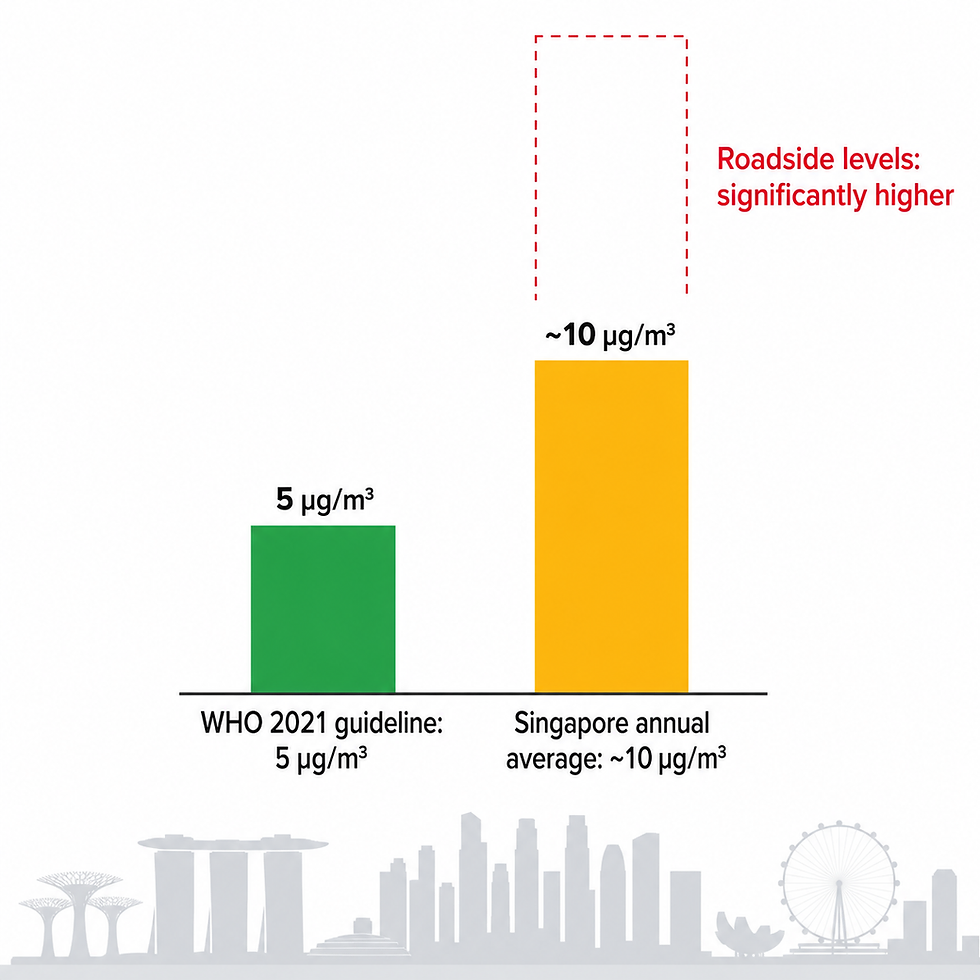
Bar chart showing Singapore's current average air quality versus WHO recommended target.
Why this matters for outdoor education
We are strong advocates for outdoor play and outdoor education. We believe every early years education facility should have access to generous outside space that their children are allowed to use for at least two hours every single day, and ideally through a structured Forest School programme. Too many children in Singapore spend their days locked up in shopping mall classrooms, some of which do not even have windows, and we think that is terrible for their development, their health, and their wellbeing.
But we cannot overcome one harm, that of being indoors too much, sedentary too much, without sufficient exposure to natural daylight and fresh air, by creating another one. If your child's nursery has a garden or outdoor play area that sits within 50 metres of a busy road, the time they spend outside may be doing them as much harm as good, and that is true whether the school calls it free play, outdoor learning, or Forest School.
This is something every parent should be thinking about, and schools and educators running outdoor programmes from sites next to busy roads should feel uncomfortable with what the evidence says about the air quality in those spaces. We understand why schools want their own outdoor space on site, and we understand the instinct that having something is better than having nothing. But there are suitable places in Singapore for outdoor programmes that are genuinely safe and appropriate for children, and using a garden next to a highway as a selling point should not come at the expense of children's health.
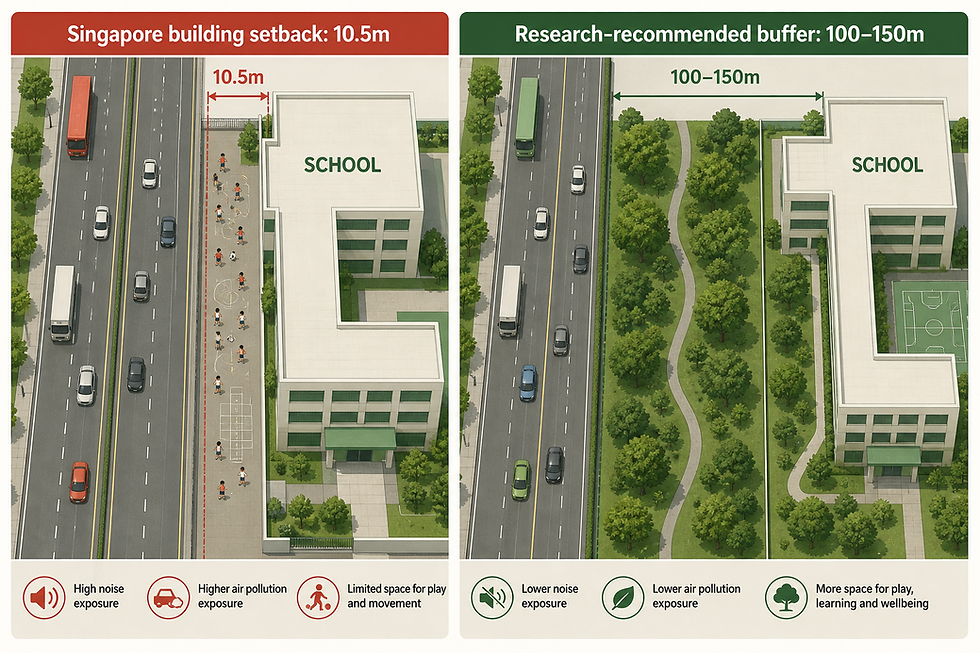
Diagram of common school locations versus ideal school siting in relation to major roads in Singapore.
What can parents do?
This is not about shaming any particular nursery. Many excellent educators work in buildings they did not choose, doing their best for children in spaces constrained by urban planning and commercial leases.
There is also a broader point here about choice. Singapore does not have a lot of available land for preschools, early years providers, international schools, or any educational establishment that wants to run outdoor programmes. The spaces that would be suitable for a forest school or an outdoor preschool are often not earmarked for that purpose by the Singapore Land Authority under the urban development plan. What the government needs to do, and perhaps is beginning to do, is make more spaces available to education providers that are healthy and suitable for children. Until that happens, providers will continue to do what they think is the best they can, often without fully understanding the harm of setting up near major roads.

But parents can ask questions now. When visiting a preschool, look at where the outdoor space is in relation to the nearest road. Ask how far the building and the play areas are set back. If the nursery is on a main road, ask what measures are in place to manage air quality during outdoor play, and check whether outdoor sessions are scheduled during peak traffic hours.
If you have the choice, and most parents in Singapore do have several options, proximity to heavy traffic is worth factoring in alongside everything else.
Our approach and why we chose the spaces we did
Part of our mission at Wildlings is to detox children from the urban environment, and that means detoxing from air pollution as well as noise pollution, as well as the visual and sensory overload of urban spaces. It all fits together.

Wildlings Dempsey
Our sites at Dempsey Hill and West Coast Park were chosen deliberately. Dempsey is surrounded by mature tropical forest, set deep within green space and well away from major arterial roads. At West Coast Park, we are near the container port, but the heavy goods vehicles do not come near us, West Coast Ferry Road is a quiet road, and we have the entire West Coast Park and sea breezes to buffer our space from West Coast Highway. The air our children breathe during Forest School is meaningfully different from the air on a roadside, and we chose those spaces for exactly that reason.
We also carefully select the spaces where we run our remote Forest School sessions and excursions, because outdoor education should be in a genuinely natural setting, in air that is clean enough to be good for children, not just convenient. When we say get outside and play in the wild, we mean in spaces where the environment itself is part of what makes it beneficial, not part of the problem.
A gap that needs filling
Singapore is a small, dense, highly urbanised island, and space is limited. Not every preschool can be in a park, but perhaps parks should come with spaces for pre-school operators to rent and not just the tired old F&B model for a change? If we can have restaurants in parks, why not preschools?
The ECDA's Code of Practice advises centres to avoid proximity to main roads, but does not specify minimum distances for outdoor play areas, and the URA's 7.5 metre building setback was not designed with children's respiratory health in mind (ECDA Code of Practice, 2025; URA Development Control Guidelines). There are no specific guidelines for preschool outdoor play area proximity to heavy traffic corridors, and this is a gap that affects the youngest and most vulnerable members of our community, this needs addressing, and parents and school operators need more choice.

Claire Seabrook is the founder of Wildlings, a Forest School and outdoor education company operating in Singapore's green spaces. She holds a first class masters degree in Environmental Science and previously worked in sustainability and air quality policy for the London Borough of Camden. Wildlings delivers programmes for children aged 18 months to 13 years at Dempsey Hill and West Coast Park.
References
1. ECDA Code of Practice for Early Childhood Development Centres, Fourth Edition (2025). Early Childhood Development Agency, Singapore.
2. URA Development Control Guidelines: Building Setback for Educational Institutions. Urban Redevelopment Authority, Singapore.
3. Gauderman, W.J. et al. (2007). Effect of exposure to traffic on lung development from 10 to 18 years of age: a cohort study. The Lancet, 369(9561), 571-577. DOI: 10.1016/S0140-6736(07)60037-3
4. Yan, M. et al. (2024). Long-term exposure to PM2.5 has significant adverse effects on childhood and adult asthma: A global meta-analysis and health impact assessment. One Earth, 7(12). DOI: 10.1016/j.oneear.2024.09.022
5. King's College London (2019). Living near a busy road can stunt children's lung growth. King's Centre for Lung Health.
6. Alter, N.C. et al. (2024). Quantifying the association between PM2.5 air pollution and IQ loss in children: a systematic review and meta-analysis. Environmental Health. DOI: 10.1186/s12940-024-01122-x
7. Zhu, Y. et al. (2002). Concentration and size distribution of ultrafine particles near a major highway. Journal of the Air & Waste Management Association, 52(9), 1032-1042.
8. Health Effects Institute (2010). Traffic-Related Air Pollution: A Critical Review of the Literature on Emissions, Exposure, and Health Effects. HEI Special Report 17.
9. US EPA (2011). Exposure Factors Handbook, Chapter 6: Inhalation Rates. EPA/600/R-09/052F.
10. Weerakkody, U. et al. (2018). Quantification of the traffic-generated particulate matter capture by plant species in a living wall and evaluation of the important leaf characteristics. Science of The Total Environment, 635, 1012-1024.
11. WHO Global Air Quality Guidelines (2021). World Health Organization.
12. ECDA Preschool Location Data, data.gov.sg (2024).
13. NEA Singapore Air Quality Monitoring. National Environment Agency, Singapore.
14. NEA Singapore Ambient Air Quality Targets. National Environment Agency, Singapore.


Comments