
What Forest School Can do for Your Bubs (12-24 Months)

As an early years educator who has spent decades taking even the youngest children outdoors, I am asked the same question by parents of babies and toddlers all the time: "Isn't my child too young for Forest School?"
My answer is always the same. This is exactly the right age to start!

At Wildlings, our Forest Babies programme is designed for children aged 12 to 24 months and their caregivers. It is unhurried, respectful of each child's developmental stage, and grounded in what research tells us about how babies learn best: through their bodies, their senses, and real experiences in the real world.
Why the Outdoors Is So Powerful in the First Two Years
The first two years of life are a period of extraordinary brain growth. According to Harvard University's Center on the Developing Child, more than one million new neural connections form every second in early childhood. These connections are not built through flashcards or apps. They are built through experience: movement, sensory input, and responsive relationships with the people around them.

Outdoor environments naturally provide the kind of rich, varied stimulation that developing brains need. Uneven ground strengthens balance and proprioception which is the body's ability to sense its own position, movement, and location in space without using vision. Natural textures support sensory integration. Open space invites curiosity. Fresh air and natural light regulate sleep cycles and mood. None of this can be replicated by a screen or a padded indoor play space.
The World Health Organization's 2019 Guidelines on Physical Activity, Sedentary Behaviour and Sleep are clear: children under one year should have no screen time at all, and children aged one to two should have no sedentary screen time. Instead, the WHO recommends floor-based play, physical activity, and varied movement throughout the day. Forest School delivers exactly this.
What the Research Tells Us
This is not a fringe idea. The evidence base for outdoor learning in early childhood is substantial and growing. Research from the University of Illinois found that access to green spaces, including trees, grass, and natural outdoor structures, before the age of two was associated with better cognitive control and emotional regulation by age four. The study also found reduced household stress in families with regular access to nature. These are not small effects. They point to something fundamental about the relationship between young children and the natural world.
In Singapore specifically, the Health Promotion Board has raised concerns about rising sedentary behaviour in young children. Early movement habits have a strong influence on physical confidence and activity levels throughout childhood and beyond. The patterns we set now tend to stick.
Harvard's Center on the Developing Child has also documented what they call "serve and return" interactions, the back-and-forth exchanges between a child and a responsive adult that build brain architecture. These interactions happen naturally outdoors, where there is always something new to notice, point at, pick up, or react to together.
What Happens When Babies Don't Get Enough Outdoor Time?
This is not about blaming busy, tired and pressured parents. Modern life in Singapore makes it hard to get outside with babies. Air-conditioned malls are convenient. Indoor play centres are easy. The heat can feel like a barrier which we all experience daily.
But we know what happens when very young children spend most of their time in controlled indoor environments. Reduced movement means slower development of core strength, balance, and coordination. Limited sensory variety can affect how confidently children explore new environments later. Over-reliance on contained spaces and screens can disrupt attention, sleep, and emotional regulation.
The good news is that these are not permanent deficits. Early, regular outdoor experiences, even once a week, can make a measurable difference. The key is starting, and starting is easier than most parents expect.
What a Forest Babies Session Actually Looks Like
Forest Babies sessions are intentionally slow and responsive. Activities are offered and not pressured, they focus on process and exploration not outcomes and specific achievement.
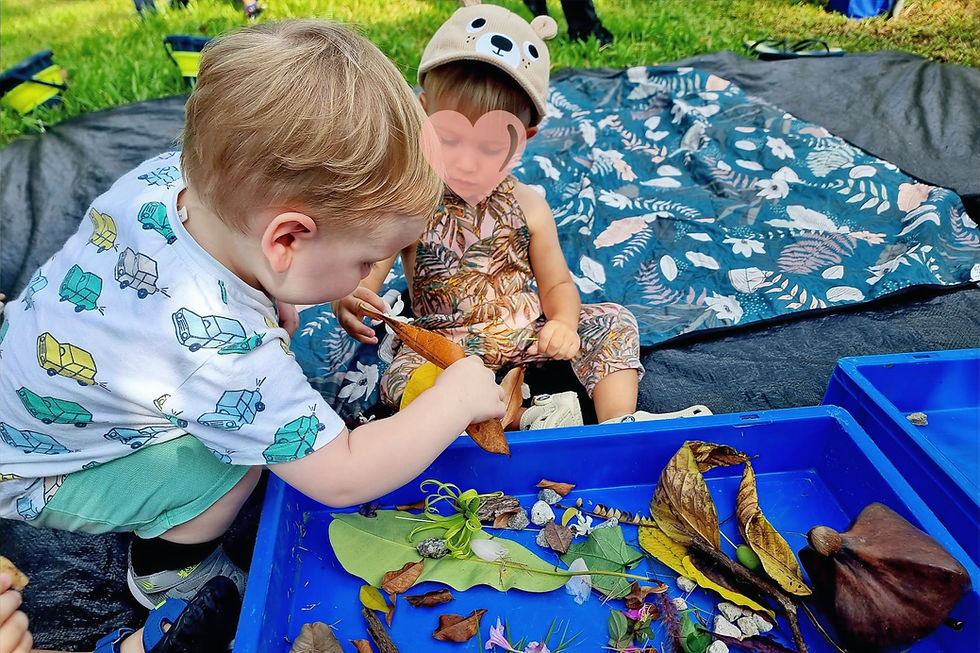
Babies are supported to move freely by crawling, cruising, walking, climbing, and balancing at their own pace over natural and constructed terrain. They explore real materials like soil, leaves, water, wood, and sand amongst sustainable and re-used materials like cardboard, pasta, bottle caps and corks. They develop early physical confidence through manageable risk and challenge. And they do all of this alongside a caregiver who is learning to observe, follow their child's lead, and resist the urge to intervene too quickly.

Code of Conduct Poster to gently encourage caregivers attending to help model and deliver the Forest School's Ethos.
Songs, simple rituals, and shared moments help babies feel oriented and safe. But the environment itself is the teacher. We prepare the space carefully, then we step back.
As Magda Gerber, the pioneering infant educator, put it: "Do less. Observe more. Enjoy most." That is the rhythm of a Forest Babies session.
It Changes Something for Parents Too
Forest Babies is as much about supporting adults as it is about supporting children. Caregivers regularly tell us that these sessions are the first time they have truly slowed down and watched their baby without distraction.
That matters. When parents learn to observe rather than direct, they start to see what their child is actually capable of. They notice the problem-solving, the determination and the physical courage. They become more confident in allowing their baby to move, explore, and take small risks. Those skills become increasingly important as children grow, and the parent who has practised trusting their child at 18 months is better equipped to keep trusting them at five, eight, and twelve.

Why Start Now?
Babies do not need to wait until preschool to benefit from Forest School. The foundations of coordination, curiosity, confidence, and resilience are already forming in the first two years. As Richard Louv observed in Last Child in the Woods, too many children are growing up with second-hand information about the natural world instead of direct experience. The earlier that pattern is broken, the better.
Our Forest Babies programme offers a research-informed introduction to outdoor learning during this critical window. For many families, it becomes the starting point of a lifelong relationship with the outdoors, and a child who is physically capable, emotionally grounded, and ready for whatever comes next.
If you are curious about Forest School for your baby, the best way to understand it is to come and experience it. No preparation needed. Just you, your child, and the outdoors, we have trials available for all sessions.
References
1. Harvard University Center on the Developing Child. "Brain Architecture." developingchild.harvard.edu
2. World Health Organization. "Guidelines on Physical Activity, Sedentary Behaviour and Sleep for Children Under 5 Years of Age." Geneva: WHO, 2019.
3. University of Illinois at Urbana-Champaign. "Green Spaces Boost Children's Cognitive Skills and Strengthen Family Well-Being." ACES News, 2023.
4. Singapore Health Promotion Board. "Singapore's Physical Activity Guidelines." hpb.gov.sg
5. Gerber, M. Dear Parent: Caring for Infants with Respect. Resources for Infant Educarers (RIE), 2002.
6. Louv, R. Last Child in the Woods: Saving Our Children from Nature-Deficit Disorder. Algonquin Books, 2005.
About Liz
Liz is a dedicated and internationally seasoned educator with over a decade of experience in diverse environments, from jungle huts to online classrooms! Liz is a mum to two little Wildlings and has recently moved to Singapore from Thailand.
Liz is passionate about fostering nature connection and outdoor learning, she enjoys yoga and sound healing.


Comments