
Schemas and Play Types: Understanding the Hidden Logic of How Children Learn

Updated: Apr 14

Have you ever watched a child throw the same ball off the same ledge twenty times in a row? Or wondered why your seven-year-old insists on wrapping every object in the house in paper? Or marvelled at a ten-year-old who spends an entire afternoon building and re-building structures?
These are not random behaviours. They are signs of deep, purposeful learning. Two frameworks help us understand what is happening: play schemas (the internal cognitive patterns driving the behaviour) and play types (the different forms that play takes). Together, they give parents and educators a powerful lens for reading what children are actually doing when they play, and why it matters at every age.
What Are Play Schemas?
Play schemas are repeating patterns of behaviour through which children explore and understand the world. The concept was developed by Professor Chris Athey, building on Jean Piaget’s work on cognitive development. Athey observed that children return to the same types of play again and again, not because they are stuck, but because they are building and reinforcing neural pathways. As Dr Daniel Siegel puts it: neurons that fire together, wire together.
Understanding schemas allows adults to see repetitive play differently. Instead of frustration ("why does she keep doing that?"), it becomes curiosity ("what concept is she working on?"). It also helps us differentiate between a child who is acting out and a child who is deep in a play urge. The difference matters.
Here are the key schemas you are likely to see, from toddlers through to primary-aged children.
Trajectory. The urge to throw, drop, kick, swing, pour, and watch things move through space. A toddler dropping food from a highchair and a ten-year-old skimming stones are both exploring trajectory. This schema is the foundation of understanding forces, speed, direction, and gravity.
Transporting. Moving objects from one place to another, in hands, bags, buckets, or wagons. This is about understanding quantity, capacity, and the satisfaction of completing a task. It appears in toddlers carting toys across the room and in older children hauling materials to build a den.

Enveloping. Covering, wrapping, hiding, and concealing objects or the self. A child who paints over a finished picture, wraps toys in fabric, or hides under blankets is exploring what happens when things disappear. This links to developing an understanding of object permanence and spatial awareness.

Enclosing. Creating boundaries and borders around spaces or objects. Drawing circles around figures, building fences for toy animals, constructing walls around a den. This is about understanding containment, territory, and spatial relationships.

Rotation. Fascination with anything that spins, rolls, or turns. Wheels, spinning tops, rolling down hills, stirring mixtures. This schema underpins later understanding of rotational symmetry, mechanical movement, and cyclical patterns in nature.

Connecting and disconnecting. Joining things together and taking them apart. Building towers and knocking them down, tying knots, linking chains. This is how children learn about construction, deconstruction, strength, and structural integrity.

Orientation. Viewing things from different angles. Hanging upside down, climbing to heights, lying flat on the ground. This builds spatial awareness, physical confidence, and the ability to see situations from multiple perspectives.

Positioning. Arranging objects in specific orders, lines, or patterns. Aligning sticks by size, sorting stones by colour, creating symmetrical designs. This links to early mathematical thinking, pattern recognition, and aesthetic awareness.

Transforming. Mixing, combining, and changing materials. Mud and water, paint colours, cooking ingredients. Children exploring this schema are investigating cause and effect, states of matter, and the irreversibility of certain changes.

Bob Hughes' 16 Play Types: A Wider Lens
While schemas describe the cognitive patterns within play, Bob Hughes' Taxonomy of Play Types describes the different forms play takes. Hughes, a playwork theorist, identified 16 distinct types of play, each contributing something different to a child's development. At Forest School, we see all of them, as we explored in The Role of Play in Forest School, and understanding them helps us create environments where every type of learner can thrive.

Here are some examples of the 16 play types:
Locomotor play is about movement for its own sake: running, jumping, climbing, rolling. It builds physical competence, spatial awareness, and cardiovascular health.
Rough and tumble play involves physical contact in a playful context: wrestling, chasing, play-fighting. Research shows this is essential for learning boundaries, reading social cues, and developing physical confidence, yet it is one of the most frequently shut down forms of play by well-meaning adults.
Exploratory play is about investigating the properties of objects and environments: what does this feel like, how does it break, what happens if I mix these together?
Object play involves manipulating objects to test their possibilities: tools, sticks, ropes, natural materials. Both are central to scientific thinking.
Imaginative play and fantasy play overlap but differ. Imaginative play involves pretending to be someone or something real (a firefighter, a parent, an animal). Fantasy play involves elements that do not exist in reality (magic powers, dragons, invented worlds). Both develop empathy, narrative thinking, and the ability to hold multiple perspectives, skills that remain important well beyond early childhood.
Social play and sociodramatic play involve playing with others, negotiating roles, rules, and storylines. These are the foundation of collaboration, conflict resolution, and emotional intelligence. Deep play involves experiences where children encounter genuine risk, testing their physical and emotional limits. This is the type of play that builds real courage and self-knowledge, and it is virtually impossible to experience in a controlled indoor environment.
Creative play involves transforming materials or ideas into something new.
Communication play includes language games, jokes, wordplay, and storytelling.
Mastery play is about practising a skill until it becomes automatic, whether that is tying a knot, balancing on a log, or carving wood.
Recapitulative play involves exploring human history and culture through play: building fires, making tools, creating shelters. This type of play is deeply satisfying for older children and is one of the reasons Forest School works so powerfully for the seven to twelve age group.
Where Schemas and Play Types Meet
Schemas tell us what the child is working on cognitively. Play types tell us how they are expressing it. A child with a strong connecting schema might engage in object play (tying knots), mastery play (repeating the skill until it is automatic), and creative play (inventing new structures). Understanding both layers gives parents and educators a much richer picture of what a child needs.
At Forest School, we use this understanding to design our environments. We provide loose parts that support multiple schemas: ropes (connecting, trajectory), containers (transporting, enveloping), varied terrain (orientation, locomotor play), and natural materials (transforming, exploratory play). The children choose what to do with them. Our job is to provide, observe, understand, and extend.
This Is Not Just for Toddlers
One of the biggest misconceptions about both schemas and play is that they only matter in the early years. They do not. Schemas continue to operate throughout childhood. A nine-year-old building an increasingly complex rope bridge is still exploring connecting, trajectory, and orientation, just at a more sophisticated level. A twelve-year-old experimenting with fire is deep in transforming, mastery play, and recapitulative play.
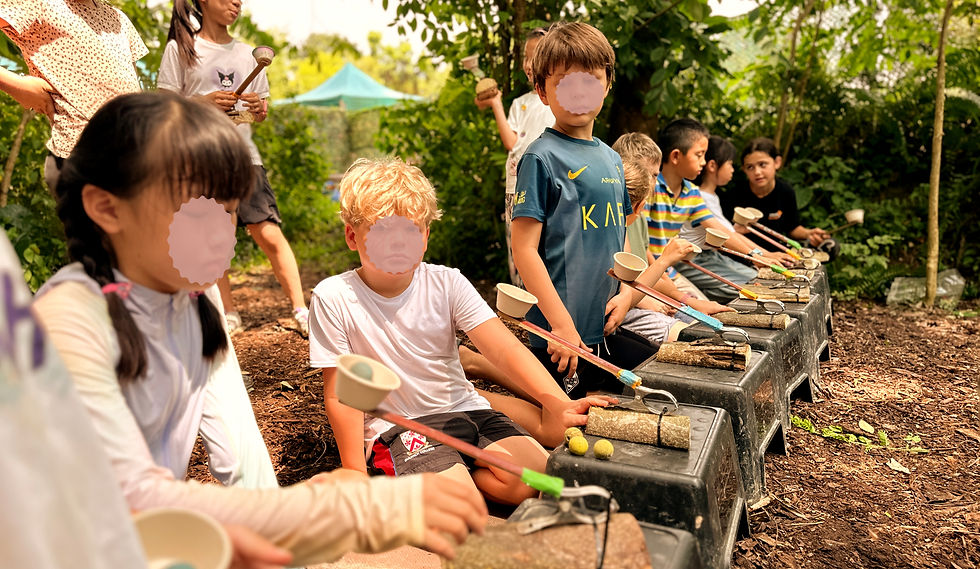
Older children in our Eagles group demonstrating rhe trajectory schema through a catapult competition.
Bob Hughes was clear that all 16 play types are important throughout childhood, not just in the early years. The forms change, the complexity increases, but the underlying drives remain. Children who are denied certain types of play, particularly deep play, rough and tumble, and recapitulative play, miss out on developmental experiences that cannot easily be replaced by other means.
This is one of the reasons Wildlings runs Forest School programmes for children up to 13 years old, not just for toddlers. Older children need these kinds of experiences just as much as younger ones. They just need it to look different: more challenging, more autonomous, more real.
What Parents and Educators Can Do
Observe before you intervene. Watch what your child does repeatedly and ask yourself which schema they might be exploring. Provide open-ended materials that support that schema. Resist the urge to redirect play that looks repetitive or messy, because that is often where the deepest learning is happening. For practical ways to apply this at home, see our guide on how to bring the Forest School ethos home.
Allow all types of play, especially the ones that make you uncomfortable. Rough and tumble play is not aggression. Deep play is not recklessness. Recapitulative play (building fires, using tools, creating shelters) is not dangerous when properly supported. These are essential experiences, and the outdoor environment is where they happen best.
When you understand both schemas and play types, you stop seeing a child who is messing about, and start seeing a child who is building the neural architecture they need to understand the world. That shift in perspective changes everything.
References
1. Athey, C. (2007). Extending Thought in Young Children: A Parent-Teacher Partnership. 2nd ed. Paul Chapman Publishing.
2. Hughes, B. (2002). A Playworker's Taxonomy of Play Types. 2nd ed. PlayLink.
3. Siegel, D.J. (2012). The Developing Mind: How Relationships and the Brain Interact to Shape Who We Are. 2nd ed. Guilford Press.
4. Nicholson, S. (1971). "How NOT to Cheat Children: The Theory of Loose Parts." Landscape Architecture, 62, 30-34.
5. Piaget, J. (1952). The Origins of Intelligence in Children. International Universities Press.
About Claire
Claire is the Founder and CEO of Wildlings, an environmental scientist by training and an environmental sustainability consultant and educator by trade. Claire is on a mission to help city kids experience a wilder childhood through the Forest School approach to learning and founded Wildlings in 2019 offering outdoor activities for children and families in Singapore.


Comments